Frontiers and Fortresses: A Michigan Tech Study Abroad in Cumbria, England
  • Blog
  • About
  • Contact

Day 27- Final Student Presentations

8/2/2014

0 Comments

 
Today marks the last full day in England as a group. It consisted mostly of the student's presentations of the papers they have been working on since they came to England. Dr. Blair had them broken up into groups and displayed it much like a conference would be set up. The presentations were set up as follows:


Construction Technology:
Billy Nolte- Stonehenge: Design and Construction
Alex Whydell- The Towers of Babel: Evolution of Building Castles
Mark Furland- Historgraphic and Cartographic Analysis of Fortifications Between the Normans and the 17th Century


Human Aspects:
Connor Olson- Hadrian's Wall
Valerie Clevenger- Venerable Bede: Father of English History
Victoria Thiel- Viking Women: Roles, Lives, and Legends


Weapon Technology/Battles/Social Movements:
Jason Rutkowski- The Longbow
Dylan Miller- The Battle of the Somme: Tactics, Technology, and Effects
Zach Christenson- Supermarine Spitfire
Dan Beegle- Development of Brough Castle: A Central Place Theory Approach
Tom Splittstoesser- The Scottish Enlightenment
Matt Pscheid- Battle of Stamford Bridge


We leave Fusehill Campus at 5am tomorrow morning in order for everyone to make their plane on time. It has been a wonderful trip with some amazing people! Thank you all for reading and following along on our journey, I hope you have all been able to follow along and get a glimpse at fun adventures we have had.
I'd also like to thank Dr. Carl Blair and Michigan Tech for putting together and making this trip a reality! 


0 Comments
 

Day 25- Classroom and Lancaster

7/31/2014

0 Comments

 
Picture
We started the day off in the classroom today. 
First we discussed how the students would present the past to the public. There were many ideas and quite a few of them revolved on a multi- audience base. It seems the students have really caught on to the fact that not everyone has the same interests and different methods would be need to appease a range of different types of people. From children, to the quick lookers, to those who are genially interested in the deep historical information  at a site. They also noticed the effectiveness of good guides and interpreters.  
Then we moved onto our lesson on the Stuarts and the Civil War. This picked up after Elizabeth's death in 1603, when James VI took over. His fame comes from the Gunpowder Plot by Guy Fawkes and his attempt at blowing up Parliament, the King James' version of the Bible, and exploration. Basically he was quite popular with the people seeing as he kept taxes low and they experienced no war during his ruling. 
Then we moved on to Charles I (1625-1649). He believed himself to be an absolute king, having the divine right to do as he wanted. He also caused problems by hating Parliament and married a Catholic, French woman. Seeing as the country was Protestant and hated the French (both due to war and extreme loss of life), one could understand the general dislike of King Charles I. In general the Stuarts as a whole rubbed the English people the wrong way. They weren't English, they mostly thought themselves divine kings, they liked France and in general disliked the people of England. Towards the end of James' rule, the 30 Years War (1618-1648) broke out due to conflict over the role of religion (mostly centered in the Holy Roman Empire). England really failed to support the Protestants despite the general population wanting to help them. 
After this Civil War broke out in 1642-1646 and 1648-1649 between Parliament and their supporters against the King and his supporters. This Civil War brought about the new form or armies as well as Oliver Cromwell. Charles I was executed in 1649. Cromwell then became the Lord Protector, and Parliament was disbanded. However things were not quite right seeing seeing as Cromwell essentially replaced James with himself. After his son Richard Cromwell took over in 1658, he was ousted in 1660. Charles II took over and continued into colonialism with the age of exploration, and conflicts with Spain.


After class we took the train down to Lancaster. 

0 Comments
 

Day 24- Back in the Cassroom

7/30/2014

0 Comments

 
We began today's class period by discussing the presentation of the past to the public, focusing on our time spent in Edinburgh the day before. We focused on the National Museum, the Merkat Tour and the Castle. We also got into an interesting side discussion on who owns the past and who has the right to make decisions on how and who displays it. Along with other political issues behind artifacts.
After a long discussion on that, we talked about the proper format for presentations as well as their papers, including proper citation. 
We soon moved into our lesson on the Tudors who reigned from 1485-1603. This included Henry VII, Henry VIII (and all of his wives), Edward VI, Bloody Mary, and Elizabeth I. Along with the Tudors we discussed their quest for legitimacy along with the political and social changes that occurred during their rule. 
0 Comments
 

Day 23- Edinburgh 

7/29/2014

0 Comments

 
Picture
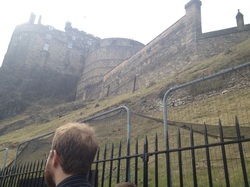
We began bright and early this morning, with the bus leaving at 7 am! We had quite a journey up to Edinburgh, Scotland. 

Student Reflection:

Hello everyone! My name is Vicky Thiel and I am studying Biology with a minor in Environmental Science at Centenary College in New Jersey. I am the only student on this trip that is not studying at Michigan Tech full time. There are two main reasons why I signed up for the Frontiers and Fortresses program. The first was to study abroad in a country that I have always adored, and the second was to experience life on my own (so to speak). I’m a commuter student still living at home so this was my first experience living away from home for a long period of time.
                  This morning was the earliest we had to wake up for a class trip. Traveling to Edinburgh took two hours and Prof. Blair wanted us to get to Edinburgh Castle as soon as it opened. So waking up at 6 in the morning was a bit difficult for some of us. Although the long bus ride was an excellent time to catch up on sleep.
                Once we arrived at Edinburgh Castle, I could see why Prof. Blair wanted us there so early. The front gate was already packed with tourists and the castle still had 10 minutes before it opened. Our group was able to walk through the pre-paid ticket line which allowed us to move much more quickly into the castle.
                  Walking through the front gate of Edinburgh Castle was like stepping into a portal to travel back in time. A cobble stone road snakes through the castle grounds and leads you higher up the hill. Looking over the castle walls, you can see why they call Edinburgh Castle the ‘castle in the sky’; the view of the city spread out below you is just breath-taking. On top of that you can see some of the Scottish hills rolling in the distance.                   We had some time to explore the castle and the few museums that were present. The best exhibit (and the only one I saw that day due to time constraints) was the Scottish Royal Crown Jewels. This exhibit took an interesting twist on presenting the history of the crown jewels before you actually saw them. Paintings, statues, and some surprisingly life-like mannequins helped make the history of the jewels and Scotland’s royal past come alive. The exhibit led down into the vault room where the actual Scottish crown jewels were kept. To see these pieces of royal history in person was a very unique experience, especially after seeing their past in the exhibit and how they survived for hundreds of years.
                  After visiting the castle, our group was led to the Scotland National Museum to get a quick look at the early history exhibit there. We didn’t linger in the museum for too long since we were given a short time to eat lunch. We had a historic ghost tour scheduled in the afternoon that could not be missed.
                  We ate lunch along the Royal Mile which is the hub of Edinburgh tourist shops and restaurants (so many cashmere shops). We all regrouped at the Marcet Cross where are wonderful tour guide Hannah, met us. She was a very entertaining guide who knew a lot of history about the city and of course the ghosts that haunt it. Hannah led us around the city telling us of some of its darker past, like when Edinburgh had to close off an entire section just to keep the plague from spreading. She finally took us to the vaults under the city were the really creepy ghost stories were told. The whole tour was incredibly entertaining.
                  The rest of the time in Edinburgh was spent wandering around the Royal Mile and nearby streets. The two hour bus ride back home once again served as an excellent time to catch up on sleep.


0 Comments
 

Day 22- Back to the Classroom & Paper writing 

7/28/2014

0 Comments

 
All students made it safely back from their individual trips from the weekend. Some got in rather late but class began at 9 am! 
Heading into the last week in England Dr. Blair went over the schedule for the week, including information on the plan for student presentations on Saturday. 

For class today, we began to discuss the 100 Years War (AD 1337-1452). This was essentially a dynastic struggle: England vs. France. We discussed important battles such as Crecy (1346), Paitiers (1356), and Agincourt (1415). We also discussed Joan of Arc, both the legend and the history.
We also discussed social issues during this time, including the rise of Parliament, trade in the urban settings (Hanseatic League), The Little Ice Age, and the beginning of the spread of The Back Death and the panic that followed it.
We spent quite some time discussing the quick spread of The Black Death and the affects it had on the people left behind. A few results: the death of ~20% of England's people, the "death" of feudalism, rural dynamic change, and inflation.


After this the students had a quiz.


Then we proceeded to discuss the War of the Roses (1455(53)- 1485). This was a dynastic struggle the grew from the 100 Years War. We discussed King Henry VII, the first Tudor to take power in England. We also went though the Battle of Towton, the bloodiest battle fought on English soil where its estimated that 30,000 men lost their lives. 
We also discussed how modern propaganda began, with the altering of history to make the War of the Roses seem like a bloodless war. Evidence from recent excavations of Towton and other battles from the War of the Roses proves it definitely wasn't bloodless.


After class was schedule to be a make-up day. However because we have had beautiful whether this entire trip (very rare!) we have a "free" afternoon. This in theory, would give students time to finish up their papers and presentations for later this week.   


Tomorrow we leave early for Edinburgh! 
0 Comments
 

Day 19- Classroom & Writing Day

7/25/2014

0 Comments

 
For today we had class as usual. We discussed the Plantagenet line, starting with Henry II. We also discussed class distinctions between Nobility, Gentry, Yomen (longbow men), and Commoners (free, serfs, vilains, and slaves) and their roles in daily life. We also discussed the role of towns and guilds. 
We then moved on to discuss the Plantagenet rivalry with France. We moved our way through King Richard I, John, Henry III and Edward I. Stopping along the way with important events during their ruling such as the Crusades, the Magna Carta, the Baron Revolt and the French Invasion. After that we moved onto the legend of Robin Hood.

For the next section of the day we discussed changes in military history during these times. Including the use of the trebuchet and the longbow.


After lunch the students had their individual meeting with Dr. Blair before being released for the free weekend. A large group of students made the long trip down to London, while others stayed in/near town. 


There will be no blog post this weekend due to the free weekend. See you next week!

0 Comments
 

Day 18- Back in Carlisle

7/24/2014

0 Comments

 
For our first day back in Carlisle, we decided to settle back in with class as usual. We started off the day by discussing the different ways we have seen people present the past. We have seen many different historical sites and students had a nice discussion on who these sites were targeting and how effective they were based on their audience.
After that we discussed Norman England after 1066. From William the Conquer to his sons, William Rufus, and Henry I. We discussed social life and the Feudal System. Then we moved on to Doomsday Book, which gave a census of England from 1085-1086. It is the first official census until the 19th century and has given historians a fantastic view of life during these times. 
After this students were asked to write on how their opinions of England and its culture has changed, then after writing for twenty minute we discussed it as a group. 
After class students signed up for their mid-evaluation meetings for tomorrow before everyone goes their own way for the weekend. Dr. Blair decided on having a rest day for students in order to take a break from the constant go go go pace. This gave students time to work on their paper/presentations and prepare for their individual weekend plans.
0 Comments
 

Day 17- Fountains Abbey & Studley Royal

7/23/2014

0 Comments

 
Picture
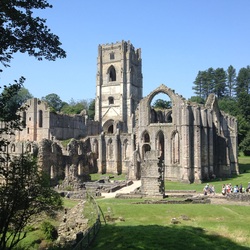
We woke up early this morning to leave York. On our journey home we stopped at Fountains Abbey and Studley Royal. We spent five hours roaming these grounds and it still was hardly enough time to take in the amazing site that is Fountains Abbey. Here is a student's perspective on the day.


Student Reflection: Dylan Miller
Hello, my name is Dylan Miller and I am studying Marketing at Michigan Tech with a minor in Historical Studies. There were two reasons that I chose this program. The first is that I have always wanted to study abroad, and second is my love of history. The combination of the two lead to Frontiers and Fortresses as being the perfect program for me.               

The morning began with our last breakfast at the hotel in York. After that we packed up everything we brought with us and started off for today’s main attraction, Fountains Abbey. There wasn't really anything special along the way. Usually we are blessed with the beautiful hills of the highlands. However we are in the lowlands today until we get closer to Carlisle.

When we arrived at Fountains we were greeted by a slight mist covering the fields with only the tower of the Abbey in view. The overcast was quickly giving way to the sun so the mist went away rather quickly. By the time we made it down to the main ruins of the Abbey the sun was shining brightly onto the magnificent stone structure of Fountains. When I say the “ruins” of Fountains Abbey, take it with a grain of salt. While it is still technically a ruin, it is still a sight to behold. The sheer size of the nave itself is enough to boggle the mind.

But before we went to look around the Abbey itself, we spent some time in the Porters Lodge, were it gave us a time line to follow during the existence of the Abbey. In the house there was also a plastic recreation of the Abbey in its glory days. I also took this moment to be a little goofy as I put on the monks robe that is there to try on and proceeded to reenact the monks from Monty Pythons Quest for the Holy Grail. If you’re not aware of it, here is a link to it here.

https://www.youtube.com/watch?v=YgYEuJ5u1K0

After having my fun as Brother Dylan, we started towards Fountains. This beauty of the Abbey is still fresh in my mind even now when I write this. The grounds have been cared for, so there is no over growth of plants yet the outside of the Abbey is surrounded by woodlands. To the right of the Abbey was the Mill that is still in operation today even if it isn't used for the purpose of grinding flour anymore. As we made through the buildings, talking pictures as we go, Professor Blair would ambush the stragglers with a pop quiz on some of the architecture style of the building. While I wasn't given a grade, I am happy to hear him say that he couldn’t disagree with what I told him. A victory for me.

Eventually we made our way back to the entrance to eat at the local restaurant for lunch. After that we took a walk around the path that loops around both Fountains Abbey and Studley Royal, the other part of the visit today. On the Studley Royal side of the land was the family’s personal church, the inside of which was very beautiful, complete with a floor mosaic that we had to put covers over shoes in order to walk on it.

Eventually as we continued on the path we entered into the area where the lake was and the river that went into it. Following the river back toward the Abbey (certain portions of the Abbey are built over the river) we came across the water gardens, which are riddled with artificial pools and shrubbery that would have been present at the time it was built. National Trust has been hard at work reconstructing the gardens to show us what it would have looked like in its heyday.

After the gardens we headed back to the visitors entrance one last time to hop on the bus to head back to Carlisle. In fact that’s when I started to write this portion of the blog, so I think I will end it here so I can get some sleep like everyone else is at the moment.


0 Comments
 

Day 16- Wall Walk & Museum Crawl

7/22/2014

0 Comments

 
Picture
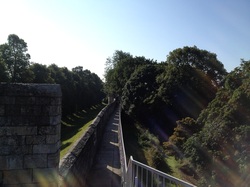
Today is our last full day in York. So to get a nice view of the old city we spent the morning walking along the wall. In addition to it being a good view of the city it gave the students more of a perspective on historical content of the city. Afterwards students were given the task to disperse and walk about the many different museums around the city. This allowed them to visit the museums that interested them. These ranged from the County Museum, the Castle Museum, Clifford's Tower and the Railway Museum. After a long day of exploring the museums, we met back up for our last meal of our York trip. Tomorrow we will journey back to Carlisle with a stop at Fountains Abbey.


Student Reflection: Danial Beegle


Today was a fair bit of walking, as we started the morning with a perimeter walk of York's medieval walls. They have been maintained by York for hundreds of years, and much of the stonework has been replaced several times. The years of weathering and many replacements have left a variety of crenelations in the wall. After making a full loop of the inner city, we split up to visit some of the major museums of York and grab lunch. Between Clifford's Tower, the Yorkshire Museum, the Castle Museum, and the National Railway Museum, we had a full afternoon of museum sites to visit and compare. I walked through Clifford's Tower and spent a while enjoying the view of York and watching volunteers try on some replica arms and armor. The Yorkshire Museum had a plethora of well preserved displays of the wildlife of Yorkshire, Roman structures, and medieval artifacts. There was even a floor with a small library and a classroom for local students to use. I took a stroll over to the National Railway Museum. While the trains themselves were interesting, they had a huge collection of railway paraphernalia. While I didn't visit the Castle Museum, I'm told they had a very in-depth exhibit on World War One history. There's a lot of interest in World War One right now due to the 100th adversary and the release of previously classified documents. We all had dinner at an Italian restaurant on York's famous Shambles street.


0 Comments
 

Day 15- York Minster, Jorvik, and Barley Hall

7/21/2014

0 Comments

 
Picture
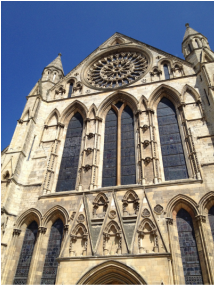
Today we were lucky enough to spend the morning in the beautiful York Minster, which is one of the largest cathedrals in Northern England. Enough cannot be said about it, so I will let our student reflection explain it.
We had lunch at an old Roman Bath Pub/Museum, here students enjoyed lunch and a tour underneath to the Roman remains below.  
After lunch we then moved on to Jorvik Viking Center, which is a museum and visitors center placed over an old Viking village. After archaeologists uncovered the village they built a museum, preserving the excavation site. Students were able to get a view of what an excavation site really looks likes, and was also, thanks to the help of Jorvik, were able to experience what life is thought to be like back in Jorvik when the Vikings ruled the area.
Then we went to Barley Hall, a reconstructed Medieval townhouse. Students were able to explore the house/museum in order to gain understanding of what life would have been like in York during these times.


Student Reflection: (Update!)
Hello there! 

First, my apologizes for the delay on the blog! I was exhausted from the days’ activities.

My name is Valerie Clevenger. I am going into my third year at Michigan Tech as a Chemical Engineer. Yesterday our group spent the first full day in York. Beginning with the York Minster. We were given three hours to explore the enormous cathedral, which was surprisingly not enough time. I can see why people spend their entire day there. The minster is divided into many sections like most Cathedrals there was a Nave, Chapter House, Organ and Quire, with the addition of Undercroft/Treasury. 

Of course the Nave is grand and beautiful with a high white ceiling and great small designs, they equipped the place with mirrors so we were able to appreciate the ceiling and a few windows without breaking our necks. After making rounds about the Nave our group was fortunate to have tickets to climb the Central Tower. Over 200 steps and it shows. The view of York is endless and wonderful - if you are afraid of heights I do not recommend this. After climbing down I took it upon myself to spend quite a bit of time studying the East end. Here they are reconstructing the gigantic stained glass window and walls. At the East Wing there was an ‘Orb’ which describes in detail the workings of the stained glass with actual displays from the window. I took a lot of interest in the restoration of it all so I spent a majority of time here. Then there was the Undercroft/Treasury located in the basement. There was a lot of information down there but the key was that when the Minster was being reconstructed for better support they dug up remains of a Roman Fort. With glass on some flooring to show the remains along with descriptions of what the Fort was like, it was really interesting. Aside from the Roman excavations they showed the history of the Church and its people and also contained the Treasury.

            Although I wasn’t able to witness this some students were able to watch/listen to a massive choir take over the Chapter House. This room is not only gorgeous but accompanied by a choir, I could only imagine it was magical. We wrapped up the day there at noon and headed to the Roman Bath House Pub. Food was good, but the real reason for going clearly lies in its name. Underneath the pub it was discovered that there were remains of an actual roman bath house. The whole system was impressive, especially for its time in 71 AD. To heat the flooring and the baths there was heat being ventilated from a furnace – the cool thing was, was that there were still scorch marks on several parts of the remains.

            After eating we headed to Jorvik, where we obtained more information about a Viking excavation which was literally shown through the glass flooring. Not only that they had a complete ride that took you through the typical day in a life of the village – even incorporating smells. Jorvik is a very popular attraction, so we interacted with the displays, took the ride and got out of there.

Our final stop of the day took place at Barley Hall. This was a medieval house which was the home to Priors of Nostell and the Mayor of York. The building actually was going to be destroyed but soon its history was discovered. Some parts even date back to the 1360’s. Inside the enormous house they were able to give a spectrum of information of what life was like during this time, examples such as medicine remedies, children’s game and even fashion. A student (Dan the Man) and I were able to play a children’s game similar to Tik-Tac-Toe. By this time our crew had been adventuring since 9 AM and it was going on 4 PM. From here everyone took their own direction to do what they please, I partook in some shopping and familiarized myself with the streets. This lasted until dinner which took place at the Ye Olde Starre Inne which is believed to be the oldest licensed premises in the city of York. Again it’s hard to make the food bad here, so we enjoyed it thoroughly. After dinner a group of us participated in a Ghost Tour about the town. We met outside of a pub and took walks with a guide who dressed all in black and was able to scare you merely from stories. I had a wonderful long day and was able to sleep well that night aside from the scary stories. Can’t wait for what’s coming up next. Thanks for your patience on my part and I hope you enjoyed!


0 Comments
 
<< Previous

    Kim Garthe

    TA in charge of Frontiers and Fortresses: Study Abroad 2014 Blog

    Archives

    July 2014

    Categories

    All

    RSS Feed


Powered by Create your own unique website with customizable templates.